

Mac Leather is a leather jacket manufacturer in Karachi. The business started in 1998 and the third generation of the family runs it now. Our own factory makes about 25,000 pieces a year: leather jackets mostly, plus leather garments, leather bags and small leather goods, for brands in the UK, Europe, North America and the Middle East. Everything from design to shipping happens in-house. We work mainly in sheepskin. Orders start at 20 pieces mixed across styles, samples take about 2 weeks for simple styles and up to 8 for complicated ones, and qualifying goods go into the UK at 0% duty under the DCTS and into the EU at 0% under GSP+. That last point is something factories in China and India can’t offer.
Pakistan’s leather industry in numbers
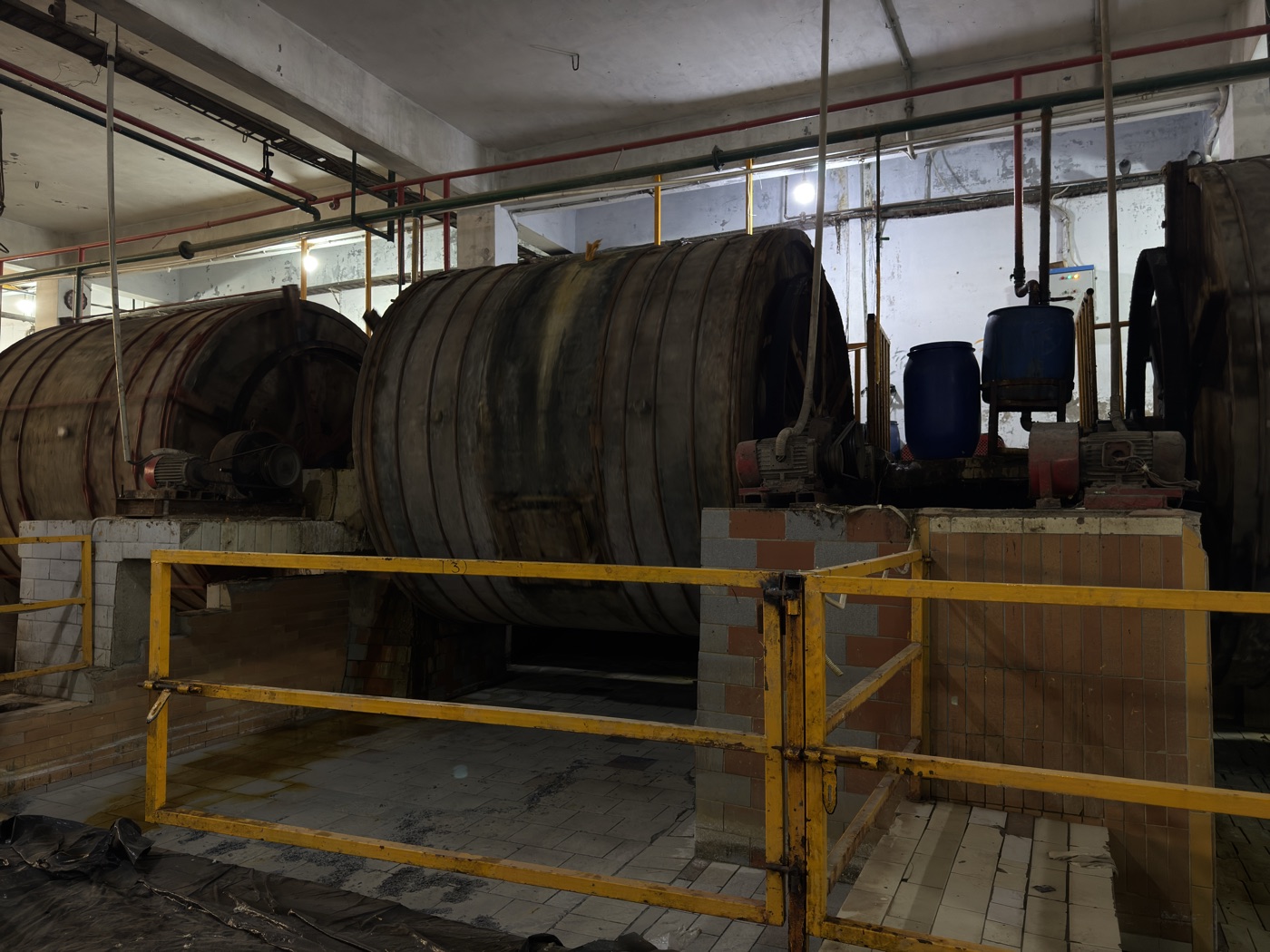
Pakistan exported roughly $683.5 million of leather in FY2024-25, which puts leather among its biggest exports outside textiles. More than 500,000 people work in it, in tanneries, cutting units, sewing rooms, finishing houses and export offices.
It starts with the animals. Pakistan has over 200 million head of livestock: about 33 million sheep, 89 million goats, 60 million cattle and 48 million buffalo. So hides are available locally all year. Factories in countries that import their skins deal with longer buying cycles and more risk. Pakistani leather goods manufacturers mostly don’t.
There are over 800 registered tanneries in the country, grouped around Karachi, Sialkot, Lahore, Kasur and Multan. About 250 of them are in Karachi’s Korangi industrial area, one of the largest tanning clusters in Asia. A hide can go from tannery to crust to finished leather to our cutting table without travelling more than a few kilometres.
The trade is old here, well over a century in these cities, and in recent years there’s been money spent on machinery, effluent treatment and training. For a buyer looking for a leather jacket manufacturer outside China and India, it’s a serious option.
The short version
- Exports: about $683.5 million in FY2024-25
- Livestock: 200M+ (33M sheep, 89M goats, 60M cattle, 48M buffalo)
- Workforce: 500,000+ across the leather trade
- Tanneries: 800+ registered, about 250 in Karachi’s Korangi cluster
- Duty: 0% into the UK on qualifying leather goods under the UK DCTS, 0% into the EU under GSP+ (since January 2014)
- Main centres: Karachi (Korangi), Sialkot, Lahore, Kasur, Multan
Why Karachi, and not Sialkot
Most buyers have heard of Sialkot first, and fair enough. Sialkot is where gloves, sports goods and motorbike race suits get made. Fashion leather is different. Jackets and garments, bags and small leather goods are mostly made in Karachi, because the tanneries, the garment machinists and the port are all in one city. If you’re looking for a leather jacket manufacturer in Karachi, that’s why.
The Korangi industrial area has about 250 tanning units packed close together. Short distances mean we can get leather quickly, and we can go and look at hides at the tannery before they’re cut.
Karachi is also the country’s commercial centre and its main port city. Karachi Port and Port Qasim handle most of Pakistan’s container trade. For a leather goods manufacturer in Pakistan that exports nearly everything, that means:
- Finished cartons reach the docks in hours, with no long drive across the country
- Lower freight costs, because there’s no inland trucking to a distant port
- Less time between final inspection and loading
- Forwarders with daily sailings to Europe, the UK, the Americas and the Gulf
We’re at S/3 Allana Road, Karachi, close to the Korangi tanneries on one side and the port on the other. For customers in the UK and Europe that means shorter lead times and a lower landed cost.
Our factory and what it can do
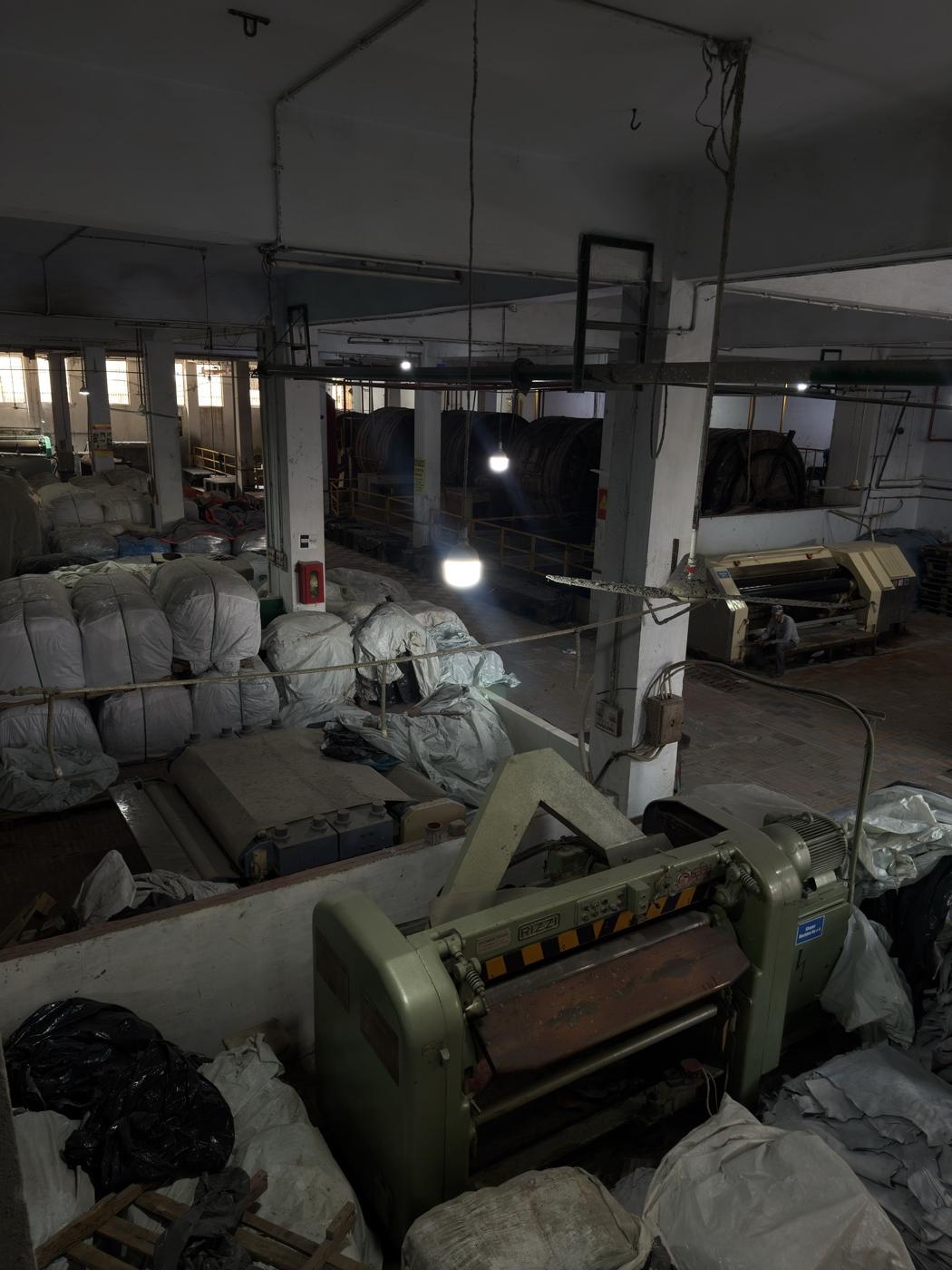
Three generations, since 1998, have built this into a factory that does every stage itself. Nothing important goes out to another workshop, so we control the quality, the timing and the cost.
What happens on the floor
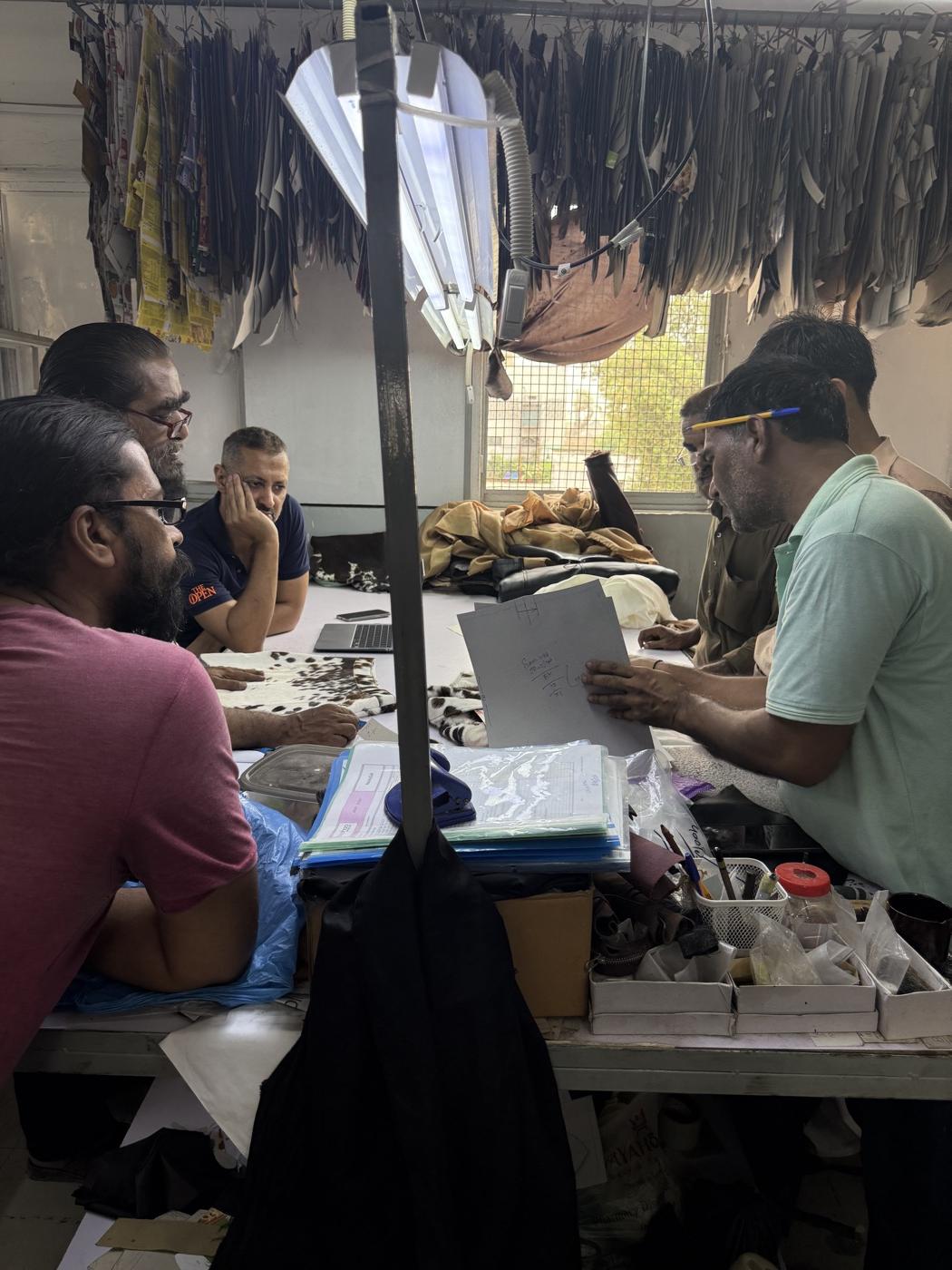
- Design and patterns: we work from tech packs, sample garments, sketches or mood boards. We cut the pattern, grade it across your sizes and make a development sample before any bulk.
- Cutting: by hand or by machine, depending on the leather and the job. A good cutter gets more panels out of a hide and keeps the grain and colour matched across a jacket, which is where a lot of the cost and the look is decided.
- Sewing: machinists who specialise in garments, bags or small goods. Machines are set up for different weights, from light sheepskin to heavy cowhide and shearling.
- Finishing: hardware and edge paint, embossing or printing, then linings and a final press. Your labels and hangtags go on at this stage.
- QC: checks after cutting, after sewing and before packing, to the AQL level you ask for. Third-party inspections by SGS, Bureau Veritas, QIMA or your own inspector are welcome.
Capacity
We make about 25,000 pieces a year, jackets first but also garments and bags. We bring in extra hands for the autumn and winter rush, so fashion customers get the capacity when they need it without paying for it all year. The minimum is 20 pieces per order, mixable across styles and colours, and a small capsule gets the same checks as a big order. Here’s how our low MOQ leather manufacturing works.
Leathers you can get from Pakistan
A good jacket starts at the tannery. With over 200 million head of livestock, Pakistan doesn’t need to import hides. We buy from tanneries we’ve used for years in Korangi and pick the hides for each order.
What we work with
- Sheepskin (our main leather)
- Soft and light, with a clean grain and good drape. It’s the best value for most jacket styles, and with around 33 million sheep in Pakistan there are no seasonal shortages. We use it for bombers, casual jackets and blazers. Our finest, lightest grades are very soft with a smooth finish, for higher-end lines.
- Cowhide (full-grain and top-grain)
- Strong and stiff. The right leather for classic bikers, moto styles and heavy outerwear that has to hold its shape. Comes in different weights, smooth or pebbled. It’s heavier to wear, which matters for some customers.
- Goatskin
- Supple, with a natural pebble grain. Lighter than cowhide but still tough, so it suits jackets that need some structure but get worn every day. Pakistan has around 89 million goats.
- Shearling
- Sheepskin tanned with the wool on. Warm, and used for winter jackets and aviators, or just for collars and linings. It sells at higher retail prices.
- Suede and nubuck
- Suede is the inner split and nubuck is the grain side buffed. Both are matte and soft. We can add a water-resistant finish if you want the jackets to cope with rain.
- PU leather
- Polyurethane for vegan or animal-free lines. Good PU looks close to leather, though it won’t age the same way.
We ask our tanneries for AZO-free dyes and arrange REACH and AZO lab tests on request. That’s the paperwork most UK and EU retailers want when they take on a new supplier.
How the 0% duty works for leather goods
A big reason to buy leather jackets from Pakistan instead of China or India is duty. There are two separate schemes, one for each market.
United Kingdom: the DCTS. Since Brexit the UK has run its own Developing Countries Trading Scheme. Pakistan is in the Enhanced Preferences tier, and qualifying leather goods made in Pakistan go into the UK at 0% import duty.
European Union: GSP+. Pakistan was granted GSP+ (Generalised Scheme of Preferences Plus) in January 2014. Finished leather apparel made in Pakistan, under HS heading 4203 (articles of apparel and clothing accessories of leather or composition leather), goes into all 27 EU countries at 0%. GSP+ depends on Pakistan keeping up 27 international conventions covering human rights and labour, the environment and governance. It has held since 2014.
So qualifying jackets from us go into both markets duty-free. Check the commodity code for each product with your customs broker before shipping.
How Pakistan compares with other leather countries:
| Country of origin | EU import duty (HS 4203) | UK import duty | Notes |
|---|---|---|---|
| Pakistan (EU GSP+ / UK DCTS) | 0% | 0% | UK: DCTS Enhanced Preferences. EU: GSP+ since January 2014, tied to governance conventions. |
| China | 4% | 4% | MFN rate. No preferential access to either market. |
| India | 4% | 4% | MFN rate. No GSP+ or equivalent for leather garments. |
| Turkey | 0% | 0% | EU customs union covers HS 4203 leather garments. Production costs often run 40 to 60% above Pakistan for similar quality. |
| Bangladesh (EBA) | 0% | 0% | Everything But Arms, for Least Developed Countries. Bangladesh leaves LDC status in 2026, which may change its access after the transition period. |
What it’s worth
Say you import 1,000 jackets at €60 CIF each. At the 4% MFN rate, buying from China or India costs €2,400 more in duty per shipment than buying from Pakistan. Three or four seasonal orders a year and that’s €7,200 to €9,600. You can pass it on, put it into better leather, or keep it.
To get the 0% rate the goods have to meet the rules of origin, which in practice means made in Pakistan from qualifying materials. We prepare the proof of origin for UK DCTS and EU GSP+ as part of the normal export paperwork. Your customs broker confirms the commodity code and makes the entry.
Read our full guide to UK DCTS and EU GSP+ duty-free leather →
Pakistan compared with the other sourcing countries
How Pakistan, and our factory in particular, stacks up against the other main places to make leather jackets.
Pakistan or China
China has huge scale, but wages there have gone up a lot in the last ten years, and a leather jacket made in China now usually costs more than one of the same quality from Pakistan. Chinese goods pay 4% MFN duty into the UK and EU, where ours pay 0%. Minimums tend to be 300 to 500 per style, lead times are longer, and language and time zones can get in the way. For smaller brands that adds up.
Pakistan or India
India makes good leather, especially around Chennai (Ambur, Vaniyambadi) and Kanpur. But Indian leather garments pay the same 4% MFN duty into the UK and EU, with no DCTS or GSP+ equivalent under HS 4203. Export procedures can also be slower. The hides are comparable, our costs are lower, and we have the duty advantage.
Pakistan or Turkey
Turkey is close to Europe, 3 to 5 days by road, and some Turkish factories are strong on design. It also gets 0% EU duty through its customs union, which covers HS 4203. The catch is cost. Wages and rents are higher, and Turkish jackets often cost 40 to 60% more than similar ones from Pakistan. You get the same 0% duty from us for less money, but you wait longer for the boat.
Pakistan or Bangladesh
Bangladesh gets 0% into the EU under Everything But Arms (EBA), the scheme for Least Developed Countries. It leaves LDC status in 2026, and after the transition that access may be cut back or removed. Its leather garment trade is also smaller than Pakistan’s for jackets, with most capacity in textiles. Pakistan’s GSP+ depends on governance conventions, not on being classed as least developed, so it’s easier to plan several seasons ahead.
In short
- 0% UK duty on qualifying leather goods under the UK DCTS, and 0% EU duty under GSP+ (since January 2014)
- Lower making costs than China, India or Turkey for similar quality
- Local hides from 200M+ livestock, so less reliance on imports
- 800+ tanneries, about 250 of them in Karachi’s Korangi cluster
- A 20-piece minimum at Mac Leather, mixable across styles, against 300 to 500+ per style at most Chinese factories
- 500,000+ leather workers, many from families who’ve done it for generations
- Managers who speak English, which cuts down on mistakes
- Karachi port: 20 to 30 days by sea to Europe, 5 to 7 days by air
How to check a leather jacket manufacturer in Pakistan
Pakistan has hundreds of leather jacket exporters, and a lot of the listings online are trading houses, not factories. Before you pay a deposit, check these with any supplier, us included:
- Factory or trader? Ask for a live video walk round the cutting and sewing floor, or come and visit.
- MOQ and lead times in writing. Ours are 20 pieces mixable across styles, about 2 weeks for simple samples and up to 8 for complicated ones, then typically 30 to 45 days for bulk after sample approval.
- A paid sample in your actual leather. Judge the stitching and the edges on that, not on a showroom piece.
- Independent inspection. A proper factory will accept SGS, Bureau Veritas, QIMA or your own inspector, and REACH/AZO lab tests on request.
- Origin paperwork. Make sure they can issue proof of origin for UK DCTS or EU GSP+, and check commodity codes with your broker.
- Payment terms on a written proforma, with the money going to a company bank account.
There’s a longer checklist in our guide on how to find a reliable leather jacket manufacturer, and why Pakistan for leather jacket manufacturing goes through the cost and duty numbers.
Compliance: what we can and can’t show you
UK and EU retailers want proof on chemicals and labour, and on environmental standards, and good stitching doesn’t answer those questions. We only claim what we can back up with documents.
- Third-party inspections: at any stage (pre-production, in-line or pre-shipment) by SGS, Bureau Veritas, QIMA or your own inspector, on top of our own checks.
- REACH and AZO lab testing: on request, at an accredited lab, against EU and UK REACH restrictions and for AZO amines, before the goods ship.
- AZO-free dyes: we specify AZO-free dyes and finishes with our tanneries.
- Labour: fair wages, safe conditions, no child labour. Clients and inspection agencies can audit the factory whenever they like.
- Environment: our tanneries take part in the effluent treatment programmes Pakistan’s environmental agencies require. Chrome waste goes through treatment plants before discharge, and we prefer tanneries that are putting money into cleaner processes.
- Where the hides come from: all the genuine leather we use is a by-product of the meat industry. No animal is raised or killed for its hide, and the hides would otherwise go to waste.
Where we ship
We’ve made orders for brands and retailers in:
- United Kingdom, including UK high street supply chain production and independent labels
- European Union: Germany, France, Italy, Netherlands, Scandinavia
- North America: United States and Canada
- Middle East: UAE, Saudi Arabia, Qatar
- Australia and New Zealand
Our export team does the commercial invoices and packing lists, the proof of origin for UK DCTS and EU GSP+, and the rest of the customs paperwork your destination port needs.
Ways to work with us
Some customers arrive with a full tech pack and a design team. Others have an idea and not much else. We work with both.
OEM manufacturing
You supply the tech packs and branding, and we make exactly that. You own the design, and we handle production and export paperwork. Most established brands with their own designers work with us this way.
Private label manufacturing
Starting a leather brand without a factory? We’ll help you get from an idea to finished stock. Design something new with us, or take one of our existing shapes and change the leather or the hardware. We put your labels and packaging on, so it arrives ready to sell.
Learn about our private label service in detail →
Wholesale leather goods
For shops and distributors who want stock without a development process. Our wholesale range covers our best-selling jackets plus bags and small leather goods, and you can change colours, hardware or branding.
Browse wholesale options and pricing tiers →
Custom and one-off projects
Limited editions, capsules, designer collaborations, promotional pieces. Short runs and awkward specs that bigger factories turn down are fine with us, including unusual materials or constructions.
What we make
Jackets are why most people first get in touch, but we make other leather goods too, and a lot of customers end up buying several categories from us.
- Leather jackets: biker, bomber, racer, blazer, aviator, shearling, trucker, moto, for men and women
- Leather bags: totes, crossbody bags, backpacks, duffles, laptop bags, clutches, messenger bags
- Leather garments: overshirts, shackets, gilets, skirts, trousers, dresses
- Belts: dress, casual, reversible, braided, custom buckles
- Wallets: bi-fold, tri-fold, card holders, zip-around, passport holders, money clips
- Gloves: dress, driving, winter-lined, touchscreen
- Accessories: keyrings, luggage tags, watch straps, coasters, desk pieces, promotional items
How an order works
-
1. Enquiry
Tell us the product, materials, quantities, target price and when you need it. Within 48 hours we’ll come back with a first view, rough pricing and any questions. Start your enquiry here.
-
2. Sample
We make a sample from your tech pack, reference garment or brief. A simple garment takes about 2 weeks, a complicated one up to 8, and we send photos before it leaves. Revisions are included until it matches your spec.
-
3. Order confirmation and materials
Once you approve the sample, we confirm the order and the unit price, and buy the production leather from our tanneries. You get a production timeline. A 50% deposit books your slot, and the balance is due before shipment.
-
4. Bulk production
Typically 30 to 45 days after sample approval. We send photos at the main stages and tell you straight away if something comes up.
-
5. Inspection and packing
Pieces are checked after cutting, after sewing and before packing. Then they’re packed your way, with polybags or dust bags, and your hangtags and barcodes. Third-party inspectors can come in at any point.
-
6. Shipping and paperwork
We arrange freight on FOB Karachi, CIF or DDP terms, do the export papers including proof of origin for UK DCTS and EU GSP+, and send tracking. Sea freight to Europe typically takes 20 to 30 days, air 5 to 7.
From first conversation to shipment usually takes 8 to 16 weeks, depending on the order size, the design and how you ship.
Questions about leather jacket manufacturing in Pakistan
What is the minimum order quantity for leather jackets from Pakistan?
At Mac Leather it’s 20 pieces per order, mixable across styles and colours. Most Chinese factories want 300 to 500 per style. We’ll also help you adjust patterns and materials to keep a small run affordable.
Do Pakistani leather jackets qualify for duty-free import to the UK and EU?
Yes, if the goods qualify. The UK charges 0% on qualifying leather goods from Pakistan under the UK DCTS (Developing Countries Trading Scheme). The EU charges 0% on finished leather apparel under HS heading 4203 in all 27 member states, through GSP+, which Pakistan has had since January 2014. Jackets from China or India pay 4% MFN. Turkey also gets 0% into the EU, but costs more to make in. Confirm commodity codes with your customs broker.
How long does it take to manufacture a leather jacket order in Pakistan?
With us, roughly 8 to 16 weeks from first conversation to shipment. That covers the sample (about 2 weeks for simple styles, up to 8 for complicated ones), revisions (5 to 7 days), bulk (30 to 45 days after sample approval) and final inspection. Add 20 to 30 days by sea to Europe, or 5 to 7 by air. We can sometimes rush an order, depending on the style and how busy the floor is.
What types of leather are available from Pakistani manufacturers?
Most of the usual jacket leathers. We use mainly sheepskin, with finer, softer grades for higher-end lines, and also full-grain cowhide and goatskin, shearling, suede or nubuck, and PU. The hides come from tanneries in Karachi’s Korangi cluster, and we arrange REACH and AZO lab tests on request.
Why is Karachi a major leather manufacturing hub?
Because the tanneries and the port are both here. Korangi has about 250 tanning units, one of Asia’s biggest clusters, so leather goes from tannery to factory in a few kilometres. Karachi Port and Port Qasim are the country’s main seaports, which means shorter lead times and cheaper freight than factories inland.
How does Pakistan compare to China, India, and Turkey for leather jacket sourcing?
On duty and price, well. Pakistan has 0% duty on qualifying leather goods into the UK (DCTS) and the EU (GSP+), where China and India pay 4% MFN. Turkey also has 0% into the EU, but making there typically costs 40 to 60% more. Pakistan also has lower labour costs, local hides and 500,000+ leather workers. At Mac Leather the minimum is 20 pieces, mixable across styles.
What compliance checks can Pakistani leather manufacturers support?
We accept third-party inspections by SGS, Bureau Veritas, QIMA or your own inspector, and arrange REACH and AZO lab tests on request. We specify AZO-free dyes, pay fair wages, and clients can audit the factory. Our tanneries are part of the government’s effluent treatment programmes.
There’s more on samples, payment terms and shipping in our leather manufacturing FAQ.
Get a quote within 48 hours
Tell us what you want made: the product, the leather, rough quantities and where you’ll sell it. That goes for a brand planning a collection, a shop after wholesale leather jackets, or someone starting a leather line from scratch. We’ll reply with unit prices, a production timeline and sample options.
- Email: info@macleatherco.com
- WhatsApp: +92 332 2121282
- Quote form: Request a quote
- Address: S/3 Allana Road, Karachi, Pakistan