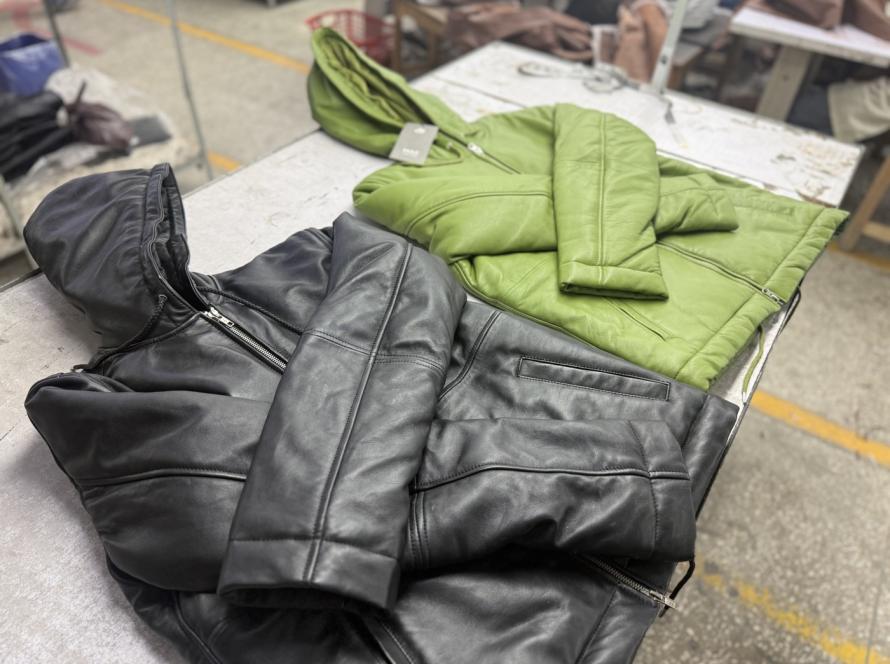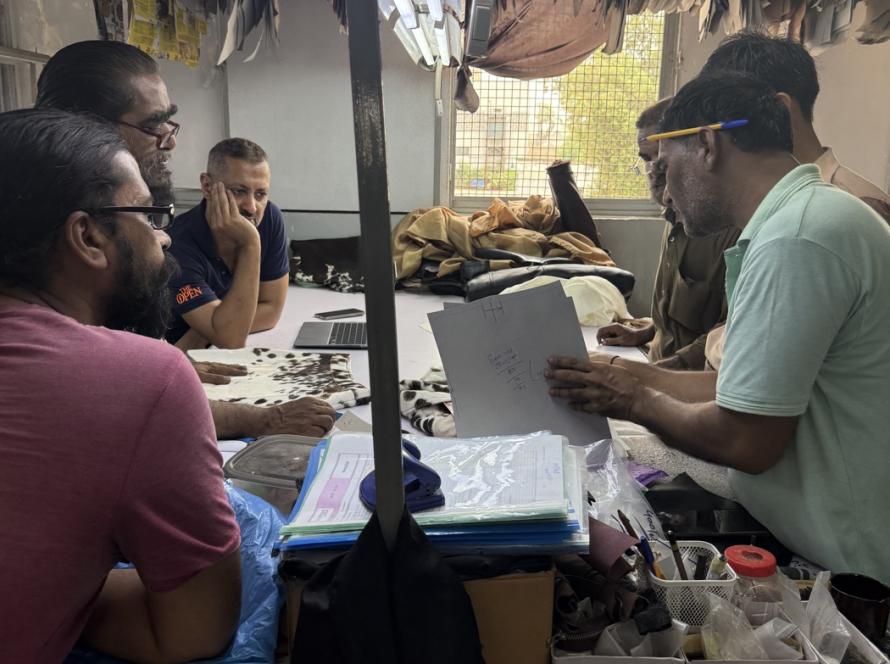

The minimum order quantity is usually one of the first numbers a factory gives you, and it shapes more of your business than the unit price does. It decides how much cash you tie up, how much stock you’re sitting on if a style doesn’t sell, and whether you can afford to test anything new. 300 pieces per style and 20 pieces per order are very different businesses, even at the same unit price.
Minimums also come in different shapes. Some apply per style, some per style per colour, some to the whole order. Our own minimum, 20 pieces per order mixable across styles and colours, is the worked example, but the same logic applies whoever you use.
Why do leather jacket manufacturers set an MOQ?
Because some costs are the same whether we make 20 jackets or 2,000.
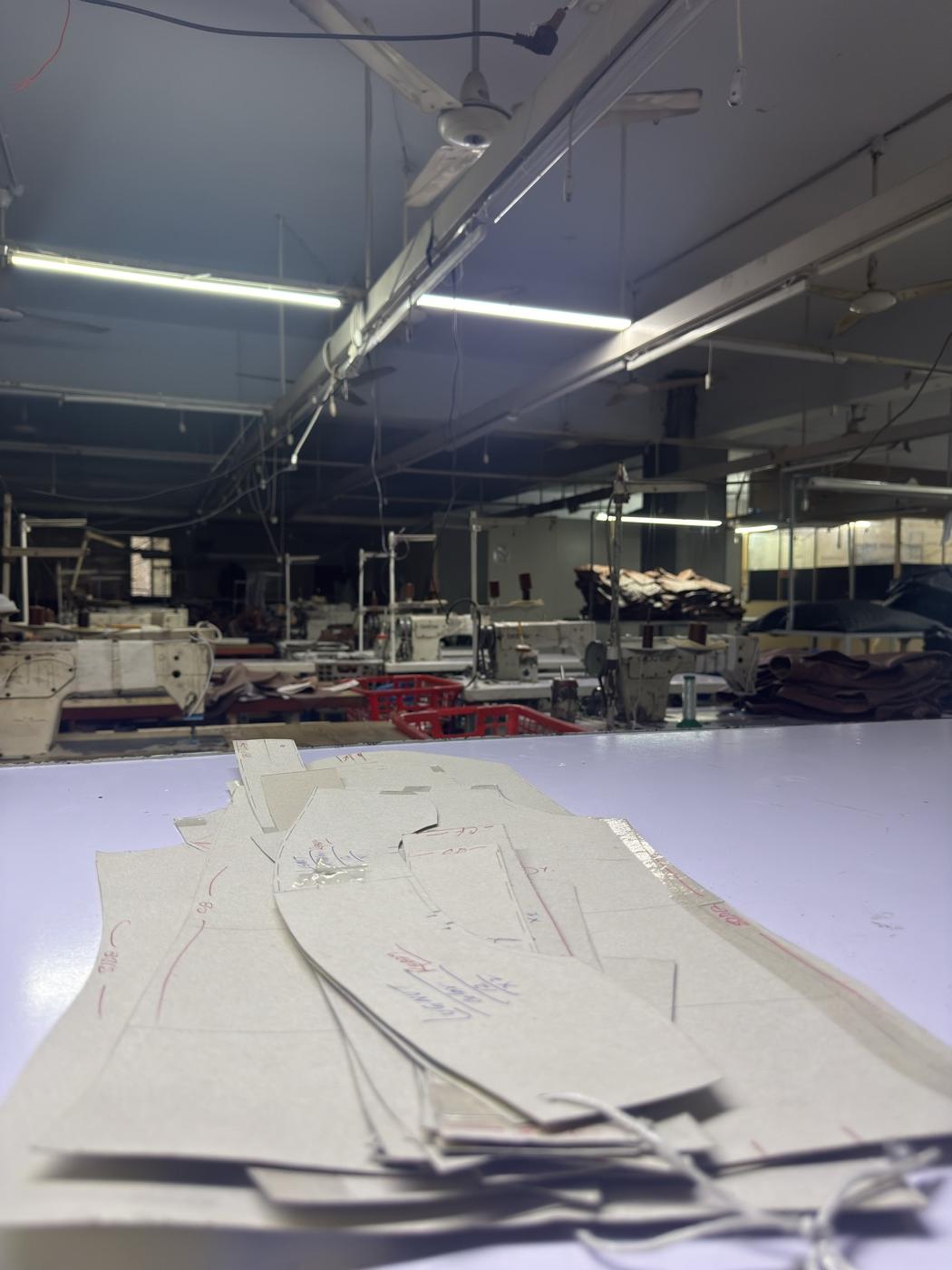
Patterns are the first. Drafting or adjusting a pattern for a new style and grading it from S to XXL takes 4 to 8 hours of a skilled pattern cutter’s time, and that doesn’t change with the size of the run.
Then there’s leather. Tanneries have minimums of their own. A particular colour or finish of sheepskin might mean buying at least 30 to 50 hides, and whatever your order doesn’t use sits on the factory’s shelf.
Setting up the line takes 2 to 4 hours before the first jacket comes off it: machines set, operators walked through the construction order, trims laid out. QC has to set its standards for each new style too: stitch count, measurements, where the hardware sits. And lines run best when they stay on one style for a good stretch. Every changeover slows things down and is a moment where mistakes creep in.
Over 500 jackets, those costs barely show in the unit price. Over 20, they’re a real part of it. That’s why small orders cost more per piece everywhere, and why a lot of factories won’t take them.
What are typical MOQs across the industry?
It varies a lot with the size of the factory, where it is and how it runs:
| Manufacturer type | Typical MOQ | Per-unit price impact | Notes |
|---|---|---|---|
| Large Chinese factory | 100 to 300 per style | Lowest base price | Built for volume. Not much flexibility for small brands. |
| Mid-size Indian factory | 100 to 300 per style | Low to moderate | Chennai and Kanpur hubs. Quality varies between factories. |
| Turkish factory | 100 to 300 per style | Moderate to high | Higher base costs offset by being close to the EU. |
| Italian artisan workshop | 50 to 200 per style | High | “Made in Italy” earns a higher retail price. |
| Low-MOQ specialist | 10 to 25 per style | 30% to 50% premium | Fine for sampling or very niche brands. Often can’t scale. |
| Mac Leather (Karachi) | 20 per order, mixable across styles and colours | Higher per piece at 20 than at 100 or 500 | Set up for small runs, with room to grow as orders get bigger. |
| Large-scale factory (any region) | 500+ per style | Lowest possible | Best prices at scale, out of reach for most independent brands. |
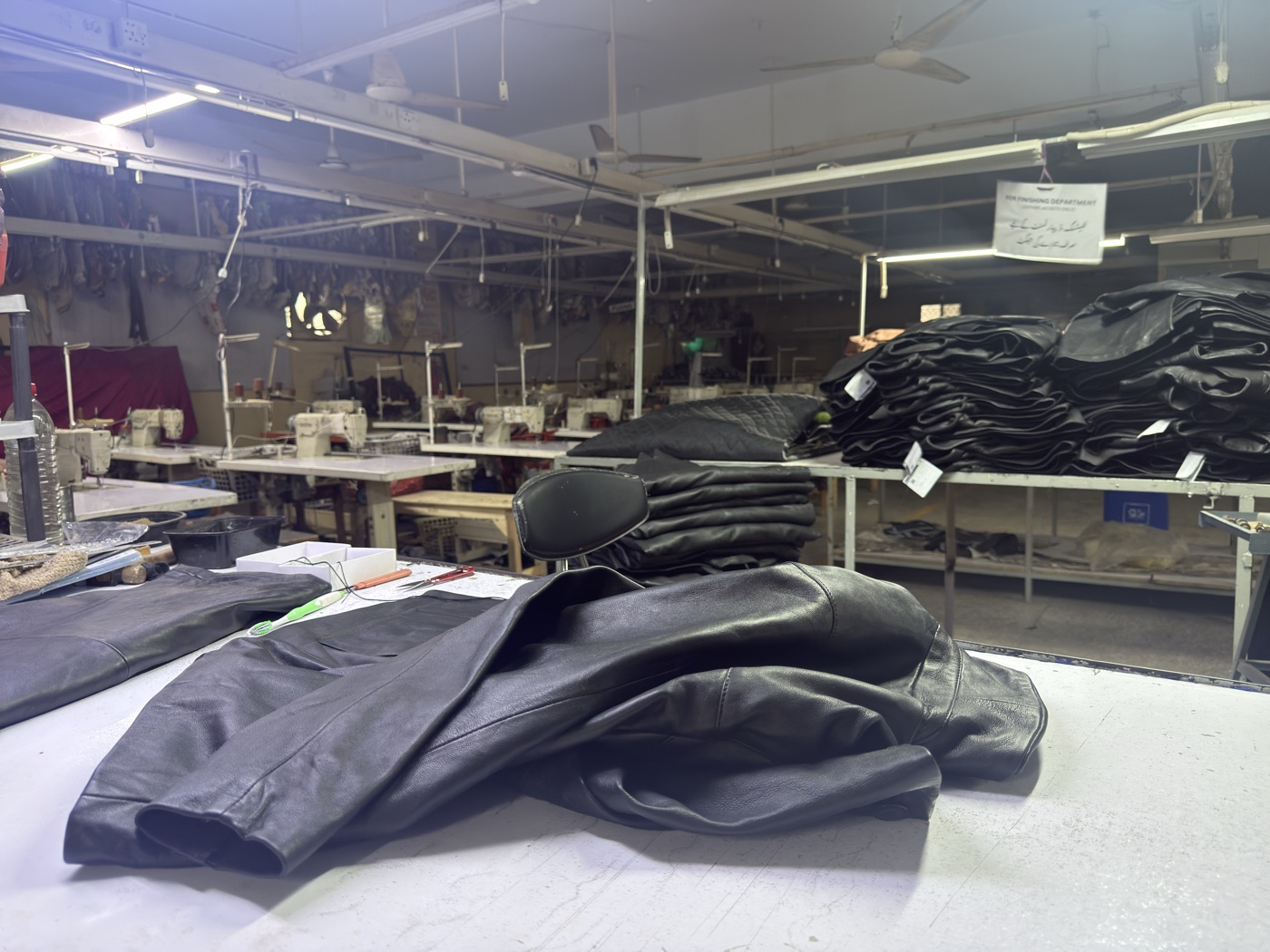
The headline number matters less than what it applies to and what you’ll pay at the quantity you’ll actually order. Compare quotes at your real order size.
How does order volume affect per-unit cost?
The curve is predictable. As the order grows, fixed costs spread over more pieces, leather buying gets more efficient and the line changes over less often. Here’s a rough illustration for a standard sheepskin bomber. Real prices depend on the leather, the construction and the trims.
| Order size | Approximate unit cost | Extra cost vs 500 units |
|---|---|---|
| 20 units | $95 to $110 | +35% to +45% |
| 50 units | $75 to $90 | +10% to +15% |
| 100 units | $70 to $82 | +5% to +8% |
| 200 units | $67 to $78 | +2% to +5% |
| 500 units | $65 to $75 | Baseline |
| 1,000+ units | $60 to $70 | 5% to 8% below baseline |
The price falls fastest between 20 and 100 pieces. Past 200 it flattens out. A 20-piece first order costs more per jacket, but it limits how much money and stock you have at risk while you find out what sells.
Under 500 pieces you’ll generally pay 15% to 45% more than big-volume bulk pricing, depending on the factory and the style. Nobody is punishing you for ordering small. That’s just what short runs cost to make.
How does MOQ apply: per style, per colour, or per order?
Buyers lose money over this. There are three common setups.
Per style per colour is common in bigger factories. A minimum of 50 means 50 of Style A in black and another 50 of Style A in brown. Two colours of one style, 100 jackets.
Per style, colour-flexible, lets you split one style’s minimum across colours, so 50 of Style A could be 30 black and 20 brown.
Per order means a minimum total, whatever the mix. That’s how we work: 20 pieces across any combination of styles and colours. It’s the most freedom you’ll get, though you still have to decide how deep each style should go, which we come to below.
Always ask which structure applies before you ask for a price. The number means nothing without it.
Size split within a small order
With a per-order minimum each style has fewer pieces, so the size split needs some thought. For one style at 8 pieces in one colour, a typical split for the UK, Europe or North America might be:
- S: 1 unit
- M: 3 units
- L: 3 units
- XL: 1 unit
At 15 to 20 pieces of one style you can add XS and XXL and follow a fuller curve, roughly 10% S, 30% M, 30% L, 20% XL, with the rest at the ends. Adjust it to your own sales. If you sell mostly in Asia, move the curve smaller. If your customers are plus-size, put more into XL and up. We help first-time buyers set ratios for their market.
How should you plan styles, colours and sizes?
At 20 pieces or 200, a few habits get more out of each order.
1. Lead with one hero style
Don’t spread a small budget thin. Put the most depth into your strongest design. In a 20-piece order that could be 12 of your main jacket in black and 8 of a second style. You get one clear product to push and enough stock to actually sell through.
2. Use existing patterns instead of full custom
A jacket from scratch means drafting a pattern, making prototypes and grading, and every step adds time and money. Starting from a factory’s base pattern and changing the details (leather and colour, hardware, lining, labels) costs a lot less to set up. We keep base patterns for every main jacket shape for exactly this reason.
3. Add colours deliberately
Because our minimum covers the whole order, you can try a second colour without doubling your spend. Still, be careful with it. Make your main style in black, your safest seller, and add one test colour. Twenty pieces over five colours gives you two or three per colour, which is almost no depth and makes reordering messy.
4. Share the plan for growth
If your first order is small, tell the factory honestly where you think it’s going. Knowing you expect to reorder helps any factory plan leather and capacity around you, and price accordingly.
5. Choose standard colours and finishes
Tanneries always have black and dark brown sheepskin in stock. Custom colours like burgundy, forest green or an unusual blue can trigger tannery minimums of 50 to 100 hides, which costs more or takes longer. For a first order, stick with stock colours.
What are the common MOQ mistakes to avoid?
Buying more than you can sell just to hit a minimum. If the factory wants 300 and you can realistically sell 100 in a season, you’ve bought 200 jackets of dead stock. Find a lower minimum instead.
Not working the structure into your budget. With a per-style-per-colour minimum, your spend is the minimum times the unit cost times the number of styles times the number of colours. A “low MOQ of 50” across four styles in three colours is 600 jackets, which could be $45,000 to $54,000 in production. Do that sum before you enquire.
Mixing up the minimum with the total. If a factory says “MOQ 50 per style per colour” and you want one style in four colours, that’s 200 pieces. Some buyers hear “MOQ 50” and assume it means 50 in total.
Choosing on minimum alone. A low minimum is worthless if the quality is poor, the communication patchy or the lead times all over the place. Our guide to finding a reliable leather jacket manufacturer covers the rest.
How does MOQ evolve as your brand grows?
Startup phase (first 1 to 3 orders)
Here the minimum is your biggest constraint. You need a factory that can work at 20 to 100 pieces an order and still hold quality. This is when a low minimum is worth the most, because it lets you test designs and find your first customers without betting too much.
Growth phase (orders 4 to 10)
You know what sells now. Orders naturally grow to 100 to 300 pieces and unit prices start to improve. The minimum stops being a problem and becomes a number you clear easily.
Established phase
At 500 or more per style the minimum doesn’t matter any more. What you care about now is capacity, reliable lead times and whether the factory can grow with you without the quality slipping. A lot of the brands we make for have gone this way, from a small first order to regular seasonal production.
Why we set our MOQ at 20 pieces, mixable
Our minimum is 20 pieces per order, and you can mix those 20 across styles and colours. A first order might be 8 biker jackets, 6 shackets and 6 totes. Or 10 bombers in black and 10 in brown. You don’t have to put 50 or 100 into one style to get started.
We can do it because of how the factory runs. We group small orders from different buyers into continuous runs, so the lines stay busy even when each order is modest. The Korangi tanneries we’ve dealt with over 25 years let us buy many leathers and colours without hitting a big material minimum every time. Our machinists work on garments and bags as well as jackets, so moving from one style to the next takes very little retraining. And everything from pattern to QC is in-house, so a small order doesn’t get passed between subcontractors.
The trade-off is simple. Per piece, 20 costs more than 100 or 500, because setup and pattern work are spread over fewer jackets. What you get in return is a small, controlled first commitment. Samples take about 2 weeks for simple styles and up to 8 weeks for complicated ones. Bulk is typically 30 to 45 days after sample approval. If minimum order size is what decides it for you, here’s more on how we work as a low MOQ leather manufacturer.
Send us your design or tech pack and we’ll come back with unit prices, a suggested size split and a lead time. You can also message us on WhatsApp.