
A bad manufacturer costs you more than a batch of bad jackets. They ship late, go quiet halfway through production, send goods that don’t match the sample you approved, and leave you explaining to your own customers why their order is late or wrong. Losing the deposit is the small part. The real cost is a lost season, damage to your name, and months spent finding someone else while your competitors keep selling.
We’re a leather jacket manufacturer in Pakistan, three generations and over 25 years in Karachi. In that time we’ve seen buyers burned by trading houses pretending to be factories, by factories that quote low and then cut corners, and by middlemen who add a margin and nothing else. Here are ten things to check before you commit to anyone.
1. Do they actually own a factory?
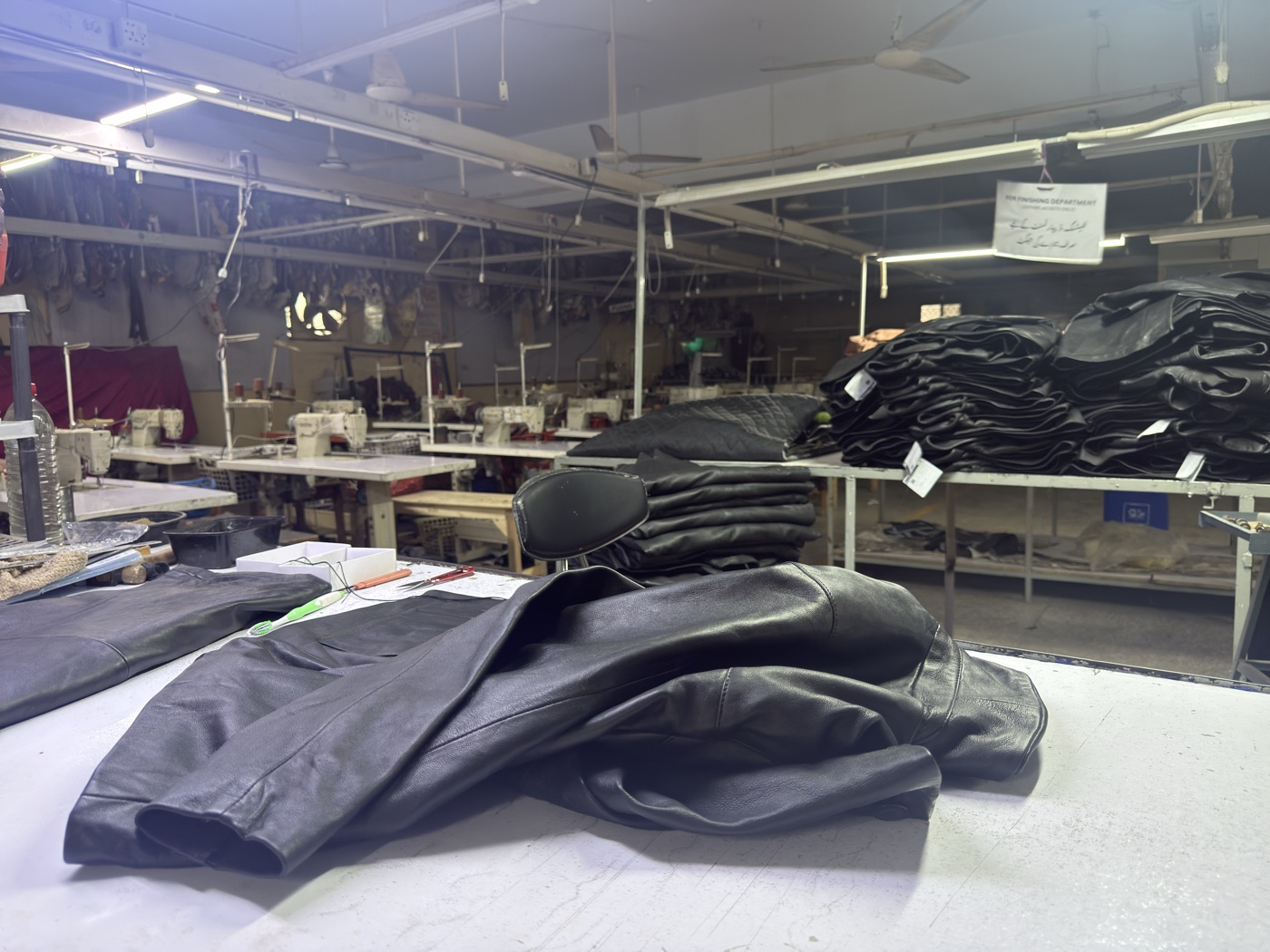
This matters more than anything else on the list, and most buyers never ask. The trade is full of export houses and agents who call themselves manufacturers but have no production floor. They take your order, pass it to whichever factory is cheapest that week, add their cut, and have very little say over quality or timing.
How to verify
- Ask for the factory address and photos of the production floor, cutting room and finishing area. A real factory has these to hand.
- Ask for a video call and a walk round. A trading house can’t show you “their” factory at short notice.
- Check the registration papers. In Pakistan the factory should be registered with the Pakistan Tanners Association (PTA) or the local chamber of commerce. In India, look for MSME registration or a factory licence.
- Ask who does the cutting and stitching. If you hear about “partner factories” or “our network”, you’re probably talking to a middleman.
Everything from cutting to QC happens in one building in Karachi. Buyers are welcome to visit, and if you can’t travel we’ll walk you round on a video call.
2. What certifications and compliance standards do they hold?
These matter because they’re checkable. They tell you whether the product is safe to sell and how the leather and the workers were treated. For leather jackets, these are the ones to know:
- REACH is mandatory if you sell in the EU. It restricts more than 200 chemicals in finished goods, including heavy metals in dyes and certain AZO dyes, as well as formaldehyde. If a factory can’t confirm REACH compliance, you can’t legally sell its jackets in Europe.
- AZO dyes fall under REACH but are worth checking on their own. Some break down into aromatic amines classed as carcinogenic, and the EU restricts them under Regulation (EC) No 1907/2006, Annex XVII, Entry 43.
- The Leather Working Group (LWG) audits tanneries on water, energy, chemical handling and waste, and rates them Gold, Silver or Bronze. Ask which LWG-rated tanneries your factory buys from.
- Some factories hold a formal quality certificate such as ISO 9001. Plenty of good specialist workshops don’t. Either way you can ask for a third-party audit, or visit and see how they work for yourself.
- SA8000 and BSCI cover labour rights, hours, pay and workplace safety.
- OEKO-TEX Standard 100 tests for harmful substances in textiles, so it’s relevant to the lining and interlining.
We work to REACH and AZO-free requirements, and we can arrange independent lab testing on a batch if you ask. Ask us which tannery a leather came from and we’ll tell you.
3. What does their quality control process look like?
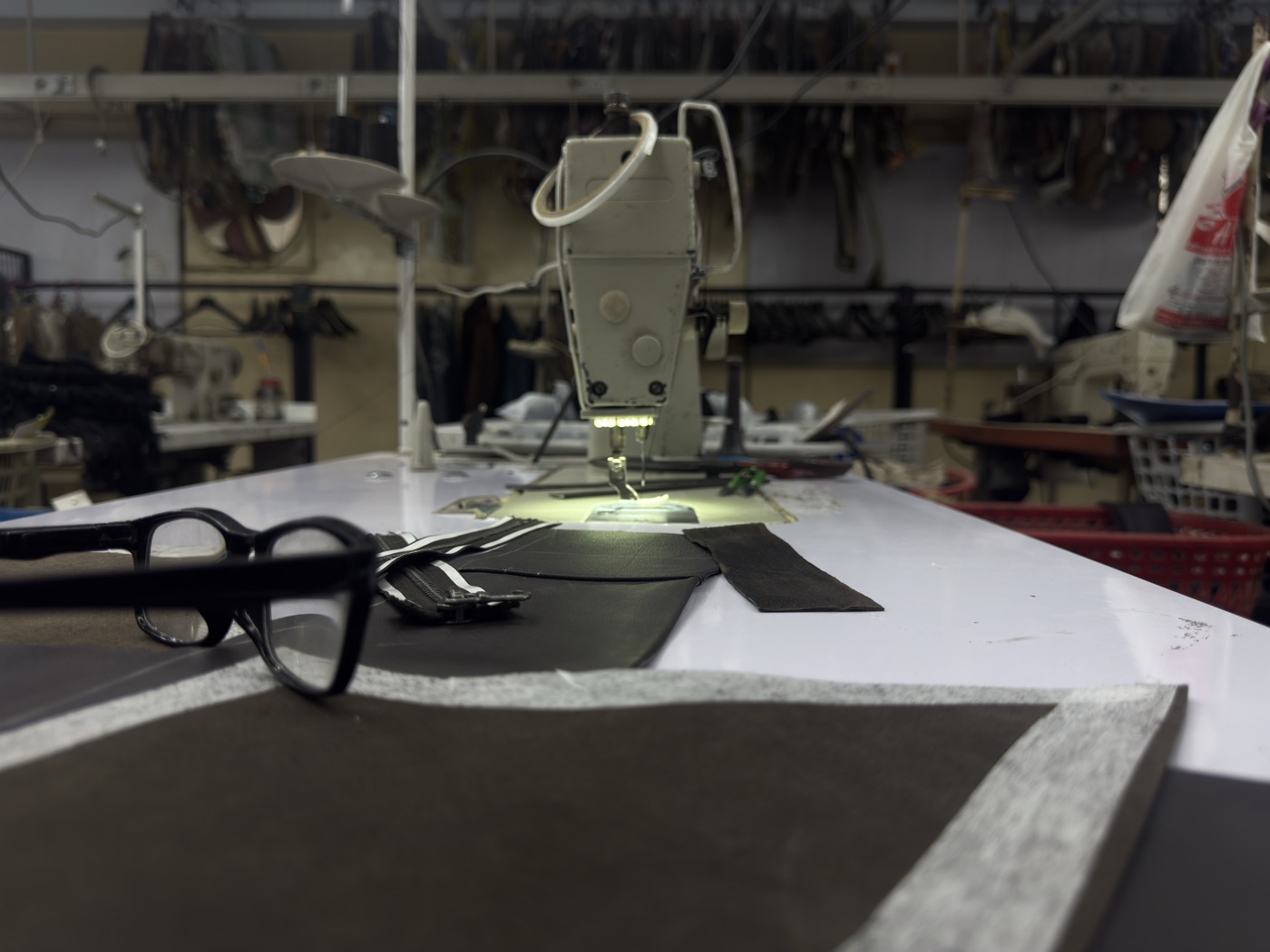
Ask them to walk you through it step by step. A serious factory checks at several stages, not once at the end.
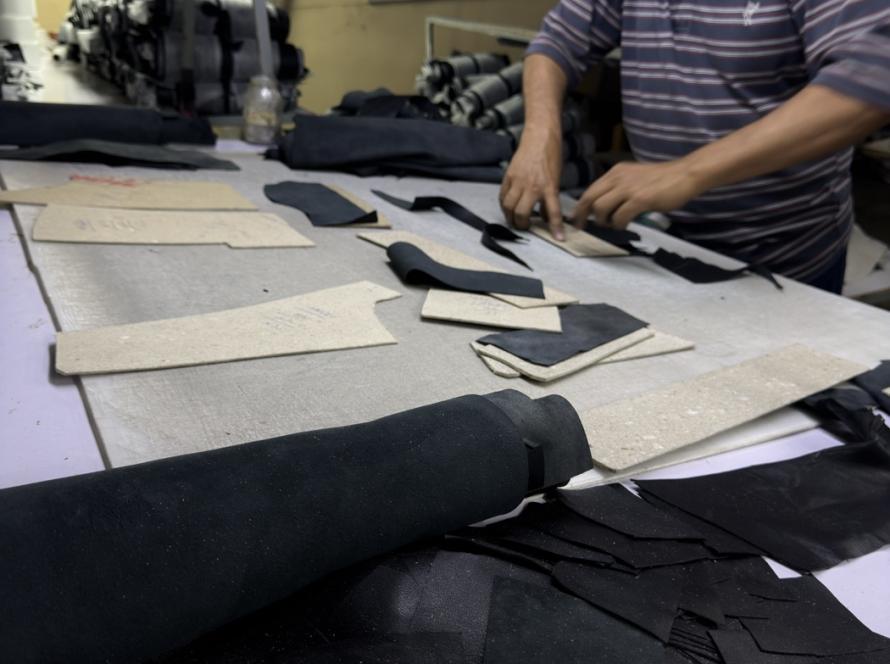
Hides are checked before cutting for scars, insect bites, uneven dye and thin spots, then sorted by shade and thickness. After cutting, pieces are checked against the pattern and for symmetry, and bad cuts are thrown out before they reach a machine. On the stitching floor someone checks stitches per inch, seam allowance, alignment and puckering while the jacket is being made, not afterwards.
Once the jacket is finished it’s measured against the size chart, to within 1 cm either way. Zips are run, snaps opened and closed, buckles checked for sharp edges, and the lining is checked for bunching. Last of all, before wrapping, someone looks over the trimming and edges, then the labels and packing.
If the answer to “what’s your QC process?” is “we check everything before shipping”, that’s one checkpoint, not a process. Faults found at the end mean expensive rework. Or they get shipped to you.
4. What is their MOQ and how flexible are they?
A factory’s minimum tells you about its size, how flexible it is and whether it wants small brands. Typical numbers:
| Factory type | Typical MOQ per style |
|---|---|
| Large Chinese factories | 200 to 500 |
| Mid-size Indian/Turkish factories | 100 to 300 |
| Specialist low-MOQ workshops | 10 to 25 (at 30 to 50% price premium) |
| Mac Leather (Karachi) | 20 per order, mixable across styles and colours |
A low minimum at a fair price, not one padded to make up for the small run, means the factory is set up for short runs. That matters a lot if you’re a startup testing designs, a small label with tight collections, or a bigger brand trying a seasonal colour.
There’s more detail in Leather Jacket MOQ Explained.
5. Can they produce a sample, and how good is it?
Any decent factory makes a pre-production sample before bulk, and the sample tells you most of what the bulk will be like.
If they push you to skip it, treat that as a warning. Leather is expensive and mistakes cost real money, so the sample is your insurance.
A simple leather jacket sample can be done in about two weeks. A complicated one can take up to eight, and any factory promising less for a heavily detailed style is guessing. Much longer can mean they’re short of capacity or sending the work out.
Expect to pay $100 to $250. That covers leather, hardware, labour and postage. If samples are free, ask yourself where that cost goes. Usually into the quality of the bulk.
Check it properly. Does it match the tech pack or the reference photos? Are measurements in tolerance? Is the leather what you asked for, in weight and in colour? A factory that can’t get the sample right won’t get the bulk right.
One or two rounds of corrections is normal. A good factory just gets on with them.
6. How responsive is their communication?
You’ll be dealing with this team for months, maybe years. Poor communication causes production mistakes, so it matters as much as the sewing.
A reply within 24 hours on working days is the least you should expect. If they take five days while they’re trying to win your order, think about what it’ll be like once they have your deposit.
Can they talk through technical specs in English, or whatever language you work in, without constant misunderstandings? Can they read a tech pack?
Do they tell you about problems before they happen? Something like “The leather you asked for has come in slightly off the approved swatch. Shall we go ahead or wait for the next batch?” That one message saves you from 200 jackets in the wrong shade.
And you should have one named contact, not a different salesperson every time who needs filling in.
7. What export documentation can they provide?
An experienced exporter should be able to give you:
- proof of origin, which you need to claim a preferential duty rate. For goods from Pakistan going into the UK under the DCTS or the EU under GSP+, it confirms Pakistani origin
- a commercial invoice and packing list for customs
- a bill of lading or air waybill
- a statement on origin (REX). Pakistani exporters registered on REX put an origin statement on the invoice. That’s what gets you 0% into the EU under GSP+, and it supports the claim for 0% into the UK under the DCTS on qualifying goods. The old paper GSP Form A has mostly gone
- REACH and AZO test results for your batch
- fumigation or phytosanitary certificates, which some countries want for goods on wooden pallets or in crates
If a factory looks blank when you mention origin statements or REACH, they either don’t export much or don’t export to regulated markets. Neither is good news.
8. Does their country of origin offer a duty advantage?
Where the jacket is made decides the duty you pay, and that goes straight into your landed cost. Current rates for leather jackets going into the UK and EU:
| Country of manufacture | UK import duty | EU import duty | Notes |
|---|---|---|---|
| Pakistan | 0% (DCTS, qualifying goods) | 0% (GSP+) | UK DCTS Enhanced Preferences; EU GSP+ beneficiary since January 2014 |
| Turkey | 0% (rules of origin apply) | 0% | UK-Turkey trade agreement; EU customs union |
| China | 4% MFN | 4% MFN | Standard tariff |
| India | Varies | 4% MFN | Standard tariff; new UK and EU trade agreements may change this once in force |
| Vietnam | Varies | Varies | UK-Vietnam and EU-Vietnam FTAs provide reduced rates for qualifying goods |
On a $50,000 shipment, 4% is $2,000 you keep. Pakistan exported about $683.5 million of leather and leather products in FY2024-25, and duty-free access is a big part of why.
9. What is their production capacity and can they scale with you?
Your first order might be 20 or 50 jackets. If things go well, your fifth might be 500 or 1,000. The factory needs to handle both.
Ask how many jackets they make a month, and see if it squares with how many brands they say they supply. 2,000 a month across 30 active brands is plausible. The maths should work.
Ask what happens in their busy months, usually July to October for autumn/winter. Do they take on extra staff? Do lead times stretch, and by how much?
And ask what happens when you double your order. Same lead time? How much notice do they need? A lot of the brands we make for started with 20 to 50 pieces and now order several hundred a season, and we plan capacity for them ahead of time.
10. Can they provide references from current clients?
A factory that’s confident in its work will put you in touch with other buyers. Some NDAs are real, but a flat refusal to give any reference at all is a warning sign.
What to ask references
- How long have you worked with them?
- Has quality stayed the same from order to order?
- Have they ever missed a delivery date, and what did they do about it?
- How do they handle faults?
- Would you use them again?
Look at their portfolio too. Photos of finished jackets tell you a lot about construction and finish, and the kind of brands they make for. If the work looks like the level you’re aiming at, that’s a good sign.
A checklist you can use today
Score any factory you’re considering against these ten points:
| # | Verification point | Pass / Fail |
|---|---|---|
| 1 | Owns their own factory (not a trading house) | |
| 2 | Can show REACH and AZO test results and name their LWG tanneries | |
| 3 | Multi-stage QC process (not just final inspection) | |
| 4 | Reasonable MOQ for your business stage | |
| 5 | Gives you a realistic sample date and keeps to it | |
| 6 | Replies within 24 hours and communicates clearly | |
| 7 | Can provide full export documentation | |
| 8 | Country of origin offers a duty advantage | |
| 9 | Has capacity to grow with you | |
| 10 | Gives references and has a solid portfolio |
A factory that passes all ten is worth backing. One that misses two or three minor points may still work out. If they fail on owning the factory, compliance or QC, walk away whatever the price.
Want to see how we score? Book a call with our team and we’ll show you the factory, how we work and our compliance paperwork. Or message us on WhatsApp.